
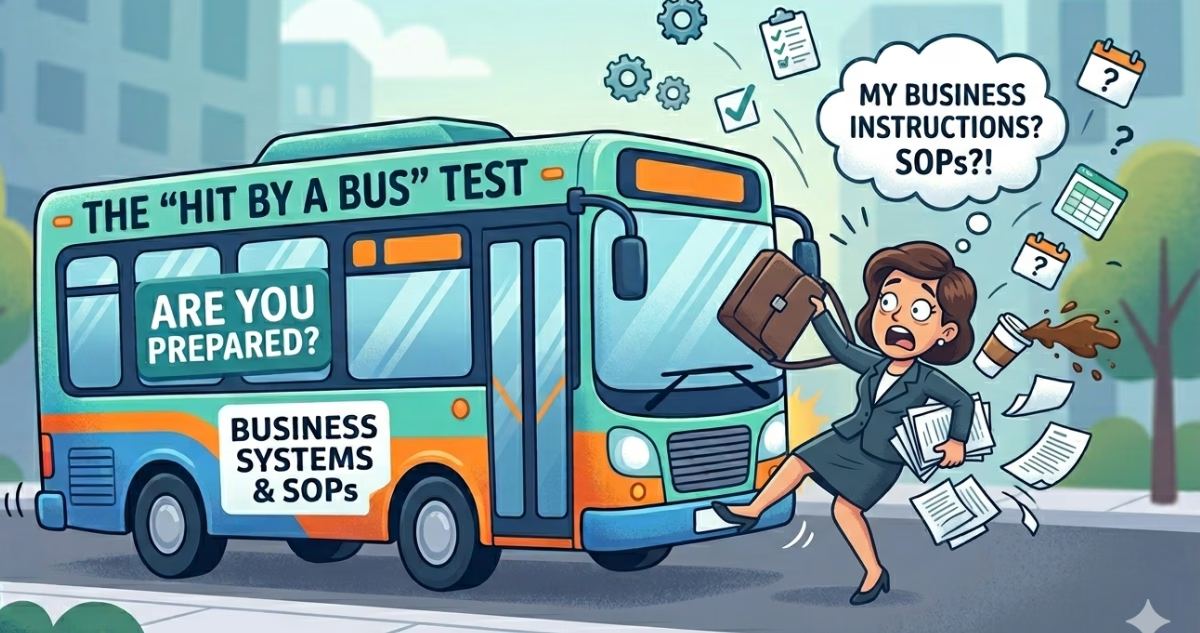
“I have it all in my head.”
It’s the most common (and most dangerous) sentence in small business. At Clear Coast Solutions, we hear it every week. It’s usually whispered by a founder who hasn’t slept since 2023.
You’ve built a successful brand, your customers love you, and the gears are turning. But there’s a catch: You are the only person who knows where they are and how to turn them.
If you caught a flu, went on a silent retreat, or (heaven forbid) got hit by a bus tomorrow, would your business still be standing by Friday?
If the answer is “probably not,” you don’t have a business. You have a high-pressure job where you are the single point of failure.
Congratulations, You’re the Bottleneck

When your processes live only in your brain, you aren’t a CEO: you’re a human FAQ page. Every tiny question from a team member or a freelancer requires a “brain drain” from you.
- “How do we format the invoices?” — Ask the boss.
- “What’s the login for the shipping portal?” — Ask the boss.
- “How do we handle a refund for a damaged item?” — Ask the boss.
- “The printer is on fire, what do I do?” — Ask the boss.
This is exhausting. It leads to decision fatigue, burnout, and and the soul-crushing realisation that you can’t even take a nap without notifications blowing up your phone.
You’re too busy being the “Instruction Manual” to actually grow your company. Most importantly, it stops you from doing the high-level work you actually enjoy and love!
IS YOUR BUSINESS BUS-PROOF?
Need a holiday?
At Clear Coast Solutions, we help you get the “Secret Sauce” out of your head and into a system that works without you. Stop being the bottleneck and start building a business that gives you your weekends back.

The Secret Map: SOPs for People Who Hate SOPs
“Standard Operating Procedure” sounds like something a guy in a grey suit would say while holding a clipboard. It’s a boring name for a life-saving tool. We like to call it differently: A map so you can go on vacation.
What is an SOP, actually? It’s the IKEA Manual for your business. It’s the step-by-step guide that shows exactly which screw goes into which hole so the whole thing doesn’t wobble. Without it, you’re just staring at a pile of Swedish particleboard and praying you don’t have “leftover parts” at the end.
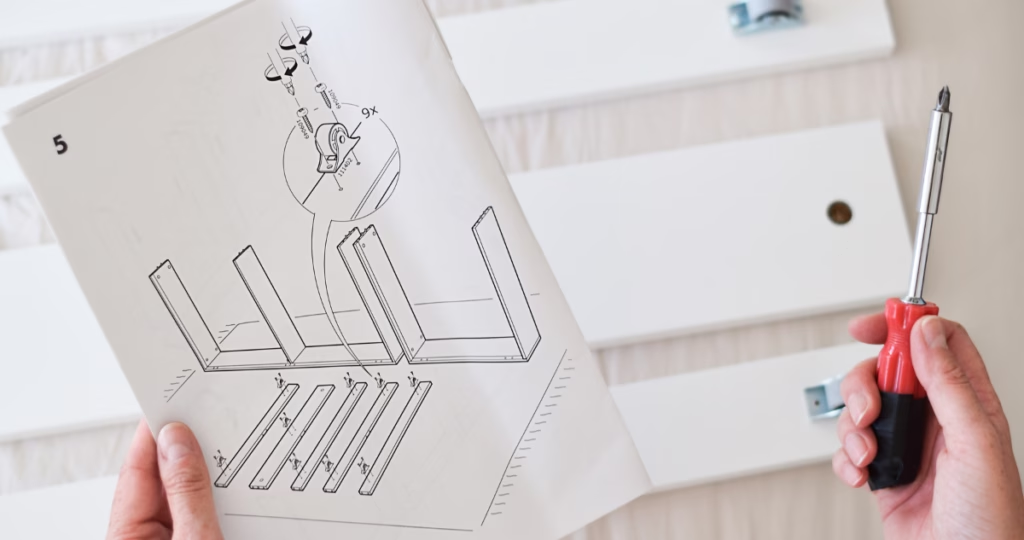
When you document your “Secret Sauce,” you’re winning on two fronts:
For You and Your Team (The “Don’t Call Me” Shield)
It turns your business into a plug-and-play system. If you want to go on vacation (or if your admin decides to quit and move to a farm), the business doesn’t stop. Your staff has the manual. They know which Allen key to use. You get to sit on a beach without receiving 50 “Quick question!” texts because someone can’t find the login for the billing portal.
For Your Customers (The “No Wobble” Guarantee)
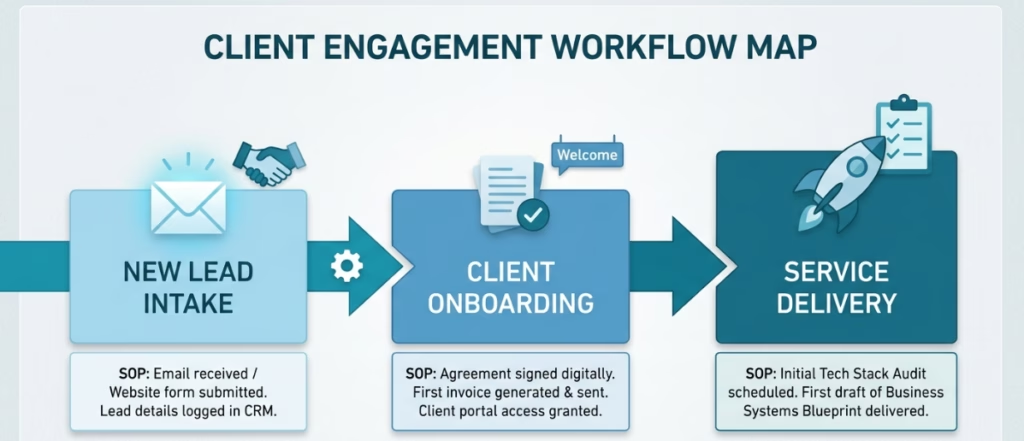
An SOP is also (secretly) a map of your Customer Journey. When you write down exactly how a lead becomes a client, you start to see where the “instructions” are confusing. You’ll realise, “Oh, wait, customers wait three days for an email here? That’s why they’re grumpy.”
By standardising the process, you ensure every customer gets the same five-star experience, whether you’re the one clicking the buttons or your newest hire is.
The bottom line: If you haven’t written the manual, you’re just winging it. And winging it is how you end up with a lopsided bookshelf and a headache.
Proof in the Library: The FT Properties & Services Story
We recently put this into practice with our clients at FT Properties & Services. After restructuring their tech stack, we created a set of simple documents and visual workflows that mapped out exactly how their new systems work.
Then, the “What If” scenario became a reality: Their admin employee moved on.
In most small businesses, a key team member leaving is a total system failure. It usually results in weeks of “detective work” where the founder wastes hundreds of hours trying to figure out passwords and processes while simultaneously trying to keep the lights on. It’s not just a headache; it’s a major security risk when the only person who knows the “master keys” to your business is no longer there.
But because the digital engine was already documented, the transition was seamless. The new office manager stepped in, followed the visual workflows, and took over without the business missing a single beat.
That is the real power of a documented system: It makes your business people-independent, but process-reliant.
SOPs Aren’t Boring Binders (It’s 2026, After All..)
The word “SOP” (Standard Operating Procedure) usually brings to mind dusty, 50-page corporate binders that nobody ever reads.
Let’s cut the crap: Nobody has time for that.
In a modern digital business, documentation should be “alive,” quick, and easy to consume. Here is how we recommend our clients document their “Secret Sauce” without losing their minds:
- The 2-Minute Loom: Don’t write it down. Just record your screen while you do the task once. Talk through what you’re doing. Save it to a “How-To” folder. Done.
- The Notion Hub: Think of this as your company’s “External Hard Drive.” It’s a central, searchable wiki where all your links, logins, and “how-to” guides live. If it’s not in Notion, it doesn’t exist. It’s way better than a messy folder of Word docs because you can actually find what you’re looking for in five seconds.
- The “Scribe” Method: There are incredible AI tools (like Scribe) that watch you do a task and automatically turn it into a step-by-step written guide with screenshots. It’s basically magic.
💡 Clear Coast Solutions Favourites: If we had to pick two “must-haves,” it would be Loom and Scribe. We LOOOOVE Scribe. It turns a five-minute screen recording into a perfect step-by-step PDF instantly. It’s the ultimate “lazy” (but brilliant) way to build your Business SOPs.
The Freedom Audit: What to Document First
You don’t need to document every single thing today. Start with the “Big Three”:
- Frequency: What do you do every single day or week? (Invoicing, social media scheduling, data entry, etc…).
- Friction: What task do you absolutely hate doing? Document it so you can hand it off to someone else ASAP.
- Fragility: What is the one thing that would cause a total disaster if it wasn’t done correctly while you were away? (Payroll, website backups, client onboarding).
Why We Build the Manual With You
When we work with clients, our goal isn’t just to “fix the back end” and disappear. We know that the real value lies in the infrastructure. As we sort out your website, streamline your tech stack, or manage your digital workflows, we are documenting as we go. We don’t just leave you with a working system; we leave you with the blueprints for that system.
Our job is to make ourselves “redundant” by ensuring that you, your future team, or your next VA can step in and keep the ship sailing without needing to call you every five minutes.
Build the Machine, Don’t Be the Gear
Documenting your “Secret Sauce” isn’t about being “corporate.” It’s about freedom. It’s the difference between owning a business and being owned by a business.
Need Help Choosing the Right Tech for Your Business?
Tired of being a human FAQ page? We help small businesses document their digital engine and streamline their workflows, making your team independent and your business unstoppable.
FAQs
We get it. But here’s the math: spending 10 minutes recording a screen-share today saves you 10 hours of answering the same question over the next year. You aren’t “writing a book”; you’re buying back your future weekends. Start small: record it once, and you never have to explain it again.
Actually, it’s the opposite. When the boring stuff (invoicing, logins, file naming) is automated and documented, you and your team have more brainpower left for the fun, creative stuff that actually makes you money. Structure doesn’t kill creativity; it gives it a playground.
This is why we hate dusty binders. In 2026, your “manual” should be a living thing. Use videos or “living” wikis like Notion. If a tool updates, you just record a quick 60-second update. It takes less time than a coffee break.
Use the “IKEA Wobble” rule: Document the task that, if skipped or done wrong, makes the whole business feel shaky. Usually, that’s stuff like client onboarding, billing, or whatever task you find yourself explaining to people over and over again.
You need something that isn’t your own skull. Whether it’s a wiki, a shared folder, or a dedicated tool, the goal is “One Version of the Truth.” If your team has to guess which Google Doc is the “current” one, you don’t have a system… you have a scavenger hunt.





Leave a Reply