

In the world of small business, there is a common myth that “doing it yourself” saves money. We treat our own time as an infinite, free resource. So why are you spending three hours on a Tuesday afternoon trying to figure out why your email signature looks weird or manually entering data into a spreadsheet?
But for a business to scale, you have to stop looking at your time as free and start looking at it as your most expensive asset. Every hour you spend on administrative “noise” is an hour you aren’t spending on the high-level strategy that actually moves the needle.
The “Reality Check” Math
To grow, you have to know what your time is actually worth to the business. If you don’t set a price for your hour, the world (and your inbox) will set it for you.
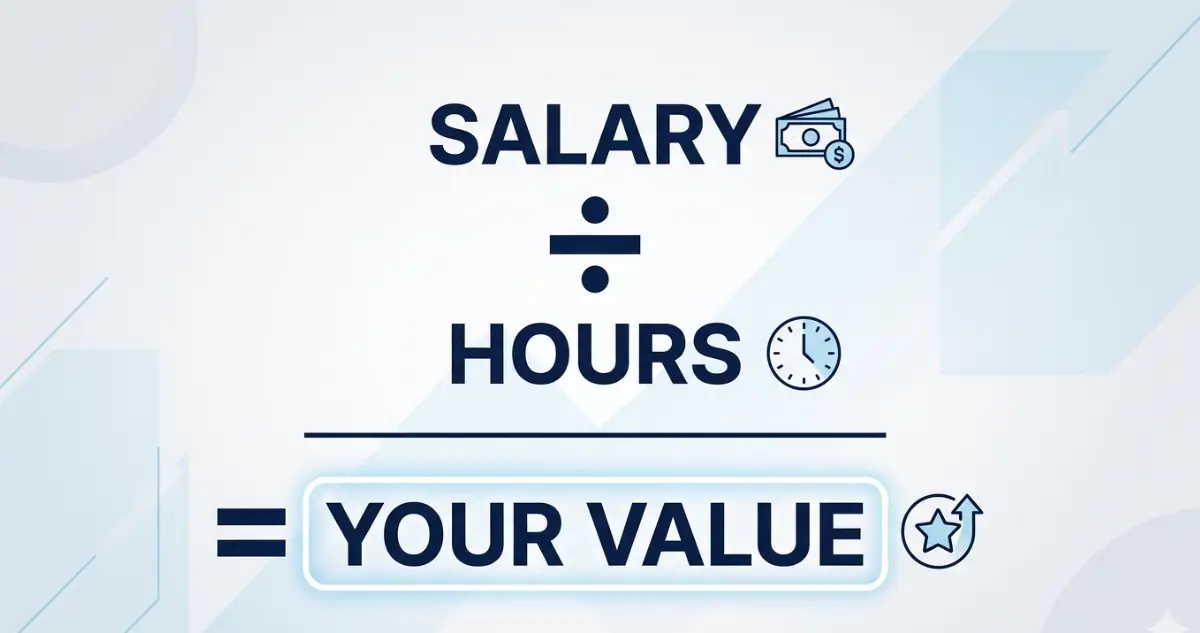
Use this formula to find your Hourly Value:
- The salary you want
- Divide this by your working hours per year
- RESULT = What your time costs
The Math in Action:
- If you want to earn $100,000/year, your time is worth $50/hr.
- If you want to earn €250,000/year, your time is worth €125/hr.
- If you want to earn £500,000/year, your time is worth £250/hr.
The Cost of “Saving” Money
Now, look at your calendar from last week. How many hours did you spend on:
- Formatting spreadsheets or invoices?
- Wrestling with software integrations?
- Data entry or basic lead follow-up?
- Scheduling and rescheduling meetings?
- Following up on unpaid invoices?
Every time you spend an hour fighting with your website, “organizing” your inbox, or chasing a $20 invoice, you are paying yourself your CEO rate to do a task that costs $20 to $50 on the open market.

If your value is €125/hr and you spent 4 hours this week troubleshooting your website or managing your inbox, you didn’t “save” money. You spent €500 of your potential salary on tasks that a specialist could have handled for approximately€200.
That €300 difference is your “Inefficiency Tax”. And most owners are paying it every single day.
The Intangible Return On Investment (ROI): Not Hating Your Life
At Clear Coast Solutions, we believe the ultimate goal of any business is to support a life you actually enjoy. The “Return on Investment” of delegating isn’t just found in your bank account; it’s found in your nervous system.
What is your “Freedom ROI”?
- Presence: Being able to have dinner with your family without checking your phone for client emails.
- Focus: Having the “deep work” time to finally launch that new product or service.
- Longevity: Avoiding the burnout that comes from wearing ten different hats when you only enjoy two of them.
- Sanity: Not wanting to throw your laptop out the window.
You can always make more money, but you can’t buy more time. Stop being your own assistant and start being the boss. When you hire a partner to handle the operational drag, you aren’t just buying a service: you’re buying your freedom back.


Ready to start?
Buy back your first 5 hours this week.
FAQs
Most business owners view their time as free because it doesn’t show up as a line item on a P&L statement. By calculating your true hourly rate, you transform your time into a quantifiable asset. This allows you to make data-driven decisions about which tasks are worth your personal attention and which are actually costing the company money by you performing them.
The Inefficiency Tax is the financial loss incurred when a high-value leader performs low-value administrative tasks. For example, if your value is $125/hr and you spend an hour on $25/hr data entry, you have effectively “taxed” your business $100. Over a year, this tax can represent tens of thousands of dollars in lost potential revenue.
The ideal time to delegate is before you hit total burnout. If you find that more than 30% of your week is spent on “operational noise”—things like scheduling, basic invoicing, or software troubleshooting—you are already overpaying your Inefficiency Tax. Starting small by “buying back” just five hours a week can provide the momentum needed to scale.
To find your baseline, use the following formula:
Hourly Value = Desired Annual Salary} divided by Total Yearly Working Hours}
Note: For a standard 40-hour work week with two weeks of vacation, use 2,000 hours as your denominator.





Leave a Reply