

In the rush to “do digital”, many small businesses have ended up drowning in a sea of apps, subscriptions, integrations and dashboards. And the ironic result? Slower growth, higher costs, frustrated teams.
At Clear Coast Solutions, we are big believers that in a noisy tech landscape, sanity wins. Let’s explore why a leaner tech stack isn’t a compromise and it’s actually a strategic asset.
The paradox of productivity
You install a new tool to fix a problem. Then you add another to plug a gap. A third to automate a manual step. Before you know it, you’ve got 12 tools, all half-used, some duplicating effort, many collecting dust. As one industry article puts it: if your stack has become “90+ applications tall (and many of those going consistently unused)”, you’re in danger of dragging growth behind you rather than driving it.
Meanwhile, doing nothing is not an option. A well-chosen tech stack can accelerate communication, reduce costs, support scalability and free your team to focus on what matters.
So the question becomes: how do you shift from “more tools” to “right tools”?
What is a tech stack?
A tech stack (short for technology stack) is the collection of software, apps, and digital tools a business uses to operate. It includes everything from your website platform, CRM, and email system to project management, accounting, and marketing tools.
In short: it’s the digital backbone of how your business runs day to day.
Signs your tool collection has turned into a liability
Here are some red flags we at Clear Coast Solutions often see in our consultancy work with small businesses:
- You have subscriptions you don’t remember why you signed up for — and you’re still paying every month!!!
- Your team toggles between multiple apps, spends time just finding the right tool, rather than doing the work. (Research shows this toggling can waste weeks per year.)
- The data you need lives in 3 or 4 different systems that don’t talk to each other. You pull manual exports and pieces don’t line up.
- New tool launches create more training overhead than benefit. The promise of “we’ll use it later” lingers.
- You are paying for under-used licences. Tools sit idle or are used only for small slices of their capability.
If this sounds familiar: congratulations, you’re not alone. And the good news is: you can fix it. Here’s how.
Too many tools, too little time?
Turn Tech Chaos into Clarity
At Clear Coast Solutions, we help small businesses cut through digital clutter and build smarter, leaner systems that actually work.

A simple roadmap to a leaner, fitter tech stack
At Clear Coast Solutions we recommend a 4-step process to declutter and align your digital tools with your growth strategy.
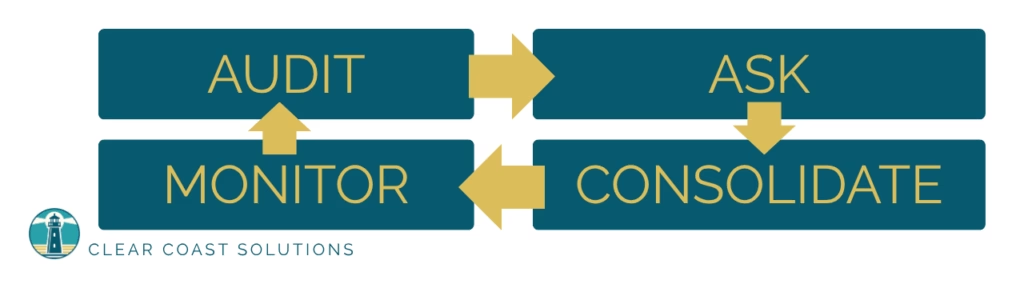
1. Audit everything (and we mean EVERYTHING!)
Start by listing all the digital tools, apps and subscriptions your organisation uses. Include even the ones someone “just downloaded one evening”.
Ask: what function does each tool serve? Who uses it? How much does it cost (licence, maintenance, training)? Does it integrate with other systems? Did I use it this week? This month?
This audit gives you the full map of your “tech clutter”. Without the map you can’t clean the house.
2. Ask the hard questions
For each tool ask:
- Is this tool critical to revenue, customer experience or internal efficiency?
- Are we using more than 60% of its features? Is usage growing?
- Does it integrate with our other tools, or is it effectively standalone/siloed?
- What happens if we took it away? Do we lose capability — or just convenience?
One blog puts it bluntly: “The more tech tools that clutter the work landscape, the more disengaged your employees will be.”
So the goal is not just fewer apps, it’s about fit.
3. Consolidate and eliminate
Once you’ve identified under-used or overlapping tools, start trimming. Some approaches:
- Find tools you can retire (and cancel licences) with minimal business disruption
- Identify overlapping tools and choose one to keep
- Ensure remaining tools integrate (via API or native connectors) so data flows freely
- Plan the transition: give your team time, training and communication.
The result: fewer platforms, less complexity, fewer hidden costs.
4. Monitor & maintain: make it a habit
A declutter is not a one-off: set a quarterly review. Track:
- Are all tools still pulling their weight?
- Are new tools needed — or are we being tempted by every “shiny app”?
- Is team adoption of existing tools rising? Or is usage slipping?
As one guide suggests: cleaning your digital workspace is like a spring-cleaning moment, but you need the regular habit to stay decluttered.
At Clear Coast we build this discipline into our consultancy engagements: tech audits + policy + training.
Why this matters for growth

When your tech stack is lean and purposeful:
- Your team spends less time wrestling with tools and more time delivering value.
- Your vendors, licences and subscriptions cost less — and you spend budget where it matters.
- You reduce risk: fewer unused apps means fewer hidden vulnerabilities, fewer integration failures, fewer orphaned data silos.
- Your systems become scalable: when you onboard a new person, a new client, a new project — you do it with clarity, not chaos.
- Ultimately, you find the signal in the noise. You’re not chasing “the next tool” but making your current stack work for you.
Clear Coast Solutions: Your partner in smart tech strategy
At Clear Coast Solutions we specialise in guiding small businesses through the noise of digital tools. We believe less is often more — when it’s the right less.
Our consultancy brings:
- A thorough audit of your current tech stack.
- Clear guidance on what to keep, what to retire, and how to integrate the remainder.
- Hands-on support to implement change and train your team.
- A habit of review, so you stay lean, agile and focused.
We’re your voice of sanity in a tech-overloaded world.
It’s tempting to think “more tools = more capability”. But in reality, every unnecessary app, licence, training session and disconnected system costs you — in money, complexity and growth.
By decluttering your digital toolkit, you free your business to do what it does best. You reclaim focus, reduce cost, and create an infrastructure for growth that’s clean, clear and future-ready.
Let’s make “less tech” mean more growth.
FAQs
A digital declutter means reviewing and simplifying your collection of apps, tools, and subscriptions. It helps reduce costs, eliminate duplication, and improve team focus and efficiency.
If your team uses multiple overlapping tools, pays for unused subscriptions, or spends more time switching between apps than doing work — your stack is likely too large or poorly integrated.
At least once a year — ideally every quarter. A quick review ensures your tools are still relevant, used effectively, and integrated properly.
Simplifying reduces wasted spending, improves productivity, strengthens data security, and makes onboarding easier for new staff or clients.
Absolutely. Clear Coast offers consultancy to audit your tools, recommend what to keep or retire, and help you build a leaner, more efficient digital setup.
Not necessarily — it means using the right tools. A focused, well-integrated stack can do more with less effort.





Leave a Reply